Compliance
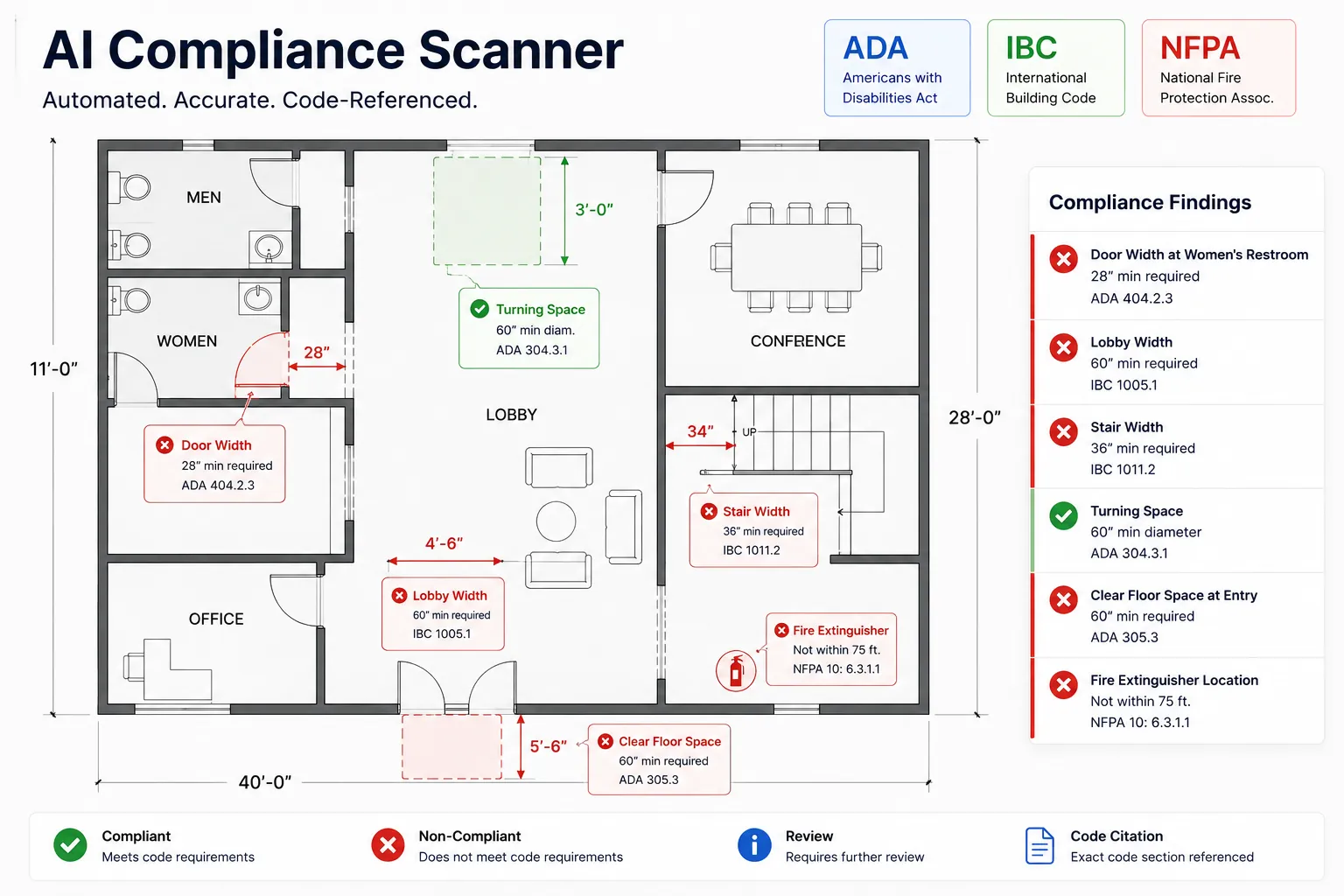
Code checks that cite their source
- ADA, FHA, IBC and NFPA rules
- Every finding cites a clause
- A reviewer approves, always
Why it is hard
Plan review is slow in the places that are easiest to mechanise
Clear widths
Door leaf and frame measured to clear opening, corridors measured between faces.Egress routes
Travel distance traced through the room graph to the nearest exit, not measured straight-line.Fire-rated doors
Rated doors located and checked against the ratings the door schedule gives them.Accessible spaces
Turning circles and clearances tested inside room polygons at the required diameter.
How it runs
Specialist models, chained
- Stage 1
Build the geometry first
A compliance check is only as good as the plan model under it, so rooms, openings and the room graph are built before any rule runs.Structured plan model - Stage 2
Run the rules that apply
The rule set is chosen for the jurisdiction and building type, and each rule is written against a specific clause rather than a rule of thumb.Findings with clause references - Stage 3
Rank and locate
Findings are ordered by severity and pinned to their location on the sheet, with the measured value beside the required one.Located, ranked findings - Stage 4
Send to a reviewer
Every finding goes to a person before it goes anywhere else. The system flags candidates; it does not certify anything.Reviewed finding list
What comes back
Data, with a trail back to the sheet
- Findings with the measured value, the required value and the clause
- A location on the sheet for every finding
- Fire-rated doors matched against schedule ratings
- Egress distances traced through the room graph
- An annotated PDF for the review meeting
This is our base model — already trained on floor plans, not yet on yours. For a project it is fine-tuned on your drawings, against a target you set, on the fields you actually use. How fine-tuning works.
Start here
See it on a drawing of your own
- One sheet is enough — PDF, DXF or a scan
- Back in about 2 business days, with an annotated overlay
- No call required, NDA on request
Send us one sheet
We run it through our floor plan models and send back the extracted data with an annotated overlay, so you can see what comes off your own drawings before anyone books a call.
- Back in about 2 business days
- PDF, DXF or a scan
- NDA on request
FAQ
Questions, answered
No, and it should not be sold as if it could. Code compliance is a professional judgement with liability attached. What this does is catch the mechanical failures early, in design development, so fewer of them reach a submission — and so the reviewer's time goes to the parts that need a reviewer.
Rules are written per project against the clauses that apply to your jurisdiction and building type. We have worked with ADA, FHA, IBC and NFPA provisions that can be checked geometrically. A rule that depends on information not present on the drawings cannot be checked from the drawings, and we say so rather than approximating.
It is flagged as unchecked rather than passed. A compliance tool that quietly assumes its way past missing information is worse than no tool, because it produces a clean report that nobody should trust.
Get in touch
Tell us what is on your drawings
Describe the sheets you get and what you need off them. We will tell you what our models already handle, what needs fine-tuning on your drawings, and what is not worth automating at all.
- Reply time
- Within 1 business day
Would rather show than tell? Send one sheet for a free analysis