Integration & deployment
It has to land where the work already happens
- API, batch or on-prem
- Your schema and field names
- You own the trained weights
Three shapes
Pick the one that matches who uses it
An API inside your product
Your platform posts a sheet and receives JSON in your own field names. Nothing in the response names us.For software teamsFor software productsA batch job for your team
A folder of drawings in, populated takeoff sheets out. No integration work, no new tool for estimators to learn.For estimating and QS teamsFor estimating & QSA service in your network
Deployed in your own cloud account or on your servers, so confidential drawings never leave your boundary.For regulated and sensitive work
Drawings and confidentiality
Your plans stay yours
- NDA signed before any drawings are shared
- Deployment in your own cloud account or on-prem where required
- Your drawings are never used to train models for other clients
- You own the weights trained on your data
Read how this works alongside fine-tuning, where the same restrictions apply to the training data.
Human in the loop
Built to be checked, not trusted blind
Review queue
Low-confidence values are held for a person, with the overlay showing exactly what the model saw.Corrections feed back
What a reviewer fixes becomes training data for the next round, so the queue shrinks over time.Thresholds are yours
Where the bar sits is a business decision — publishing a listing and pricing a bid are not the same risk.
Start here
Start with the output, not the plumbing
- One sheet is enough — PDF, DXF or a scan
- Back in about 2 business days, with an annotated overlay
- No call required, NDA on request
Send us one sheet
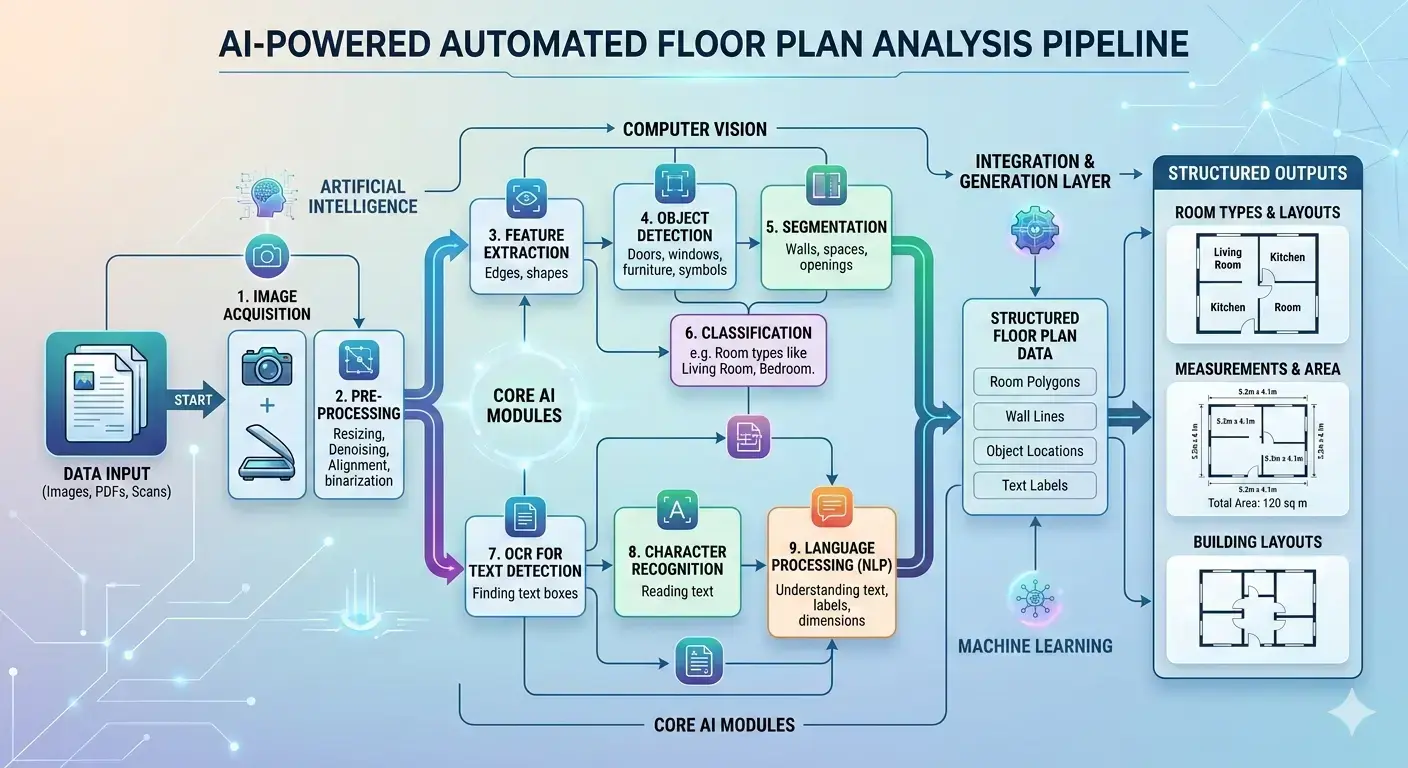
We run it through our floor plan models and send back the extracted data with an annotated overlay, so you can see what comes off your own drawings before anyone books a call.
- Back in about 2 business days
- PDF, DXF or a scan
- NDA on request
FAQ
Questions, answered
Not there yet? Start with one sheet.
No. There is no sign-up page, no API key to generate and no price list, because every deployment runs a model tuned to one client's drawings. What we deliver is an endpoint built for you, with the fields you agreed.
Yes. Where drawings cannot leave a network at all, the pipeline is deployed on your own hardware with no outbound calls. It is a normal request in defence, government and some contractor work.
Sheets are processed independently, so volume is a matter of how much compute is provisioned rather than a limit in the pipeline. Batch archives and steady per-upload traffic are sized differently, and we scope that against your actual numbers.
Usually us, because drawing mixes shift and models drift. Some clients take the pipeline in-house to run themselves. Both work, but it is better decided before the build than after it.
Get in touch
Tell us what is on your drawings
Describe the sheets you get and what you need off them. We will tell you what our models already handle, what needs fine-tuning on your drawings, and what is not worth automating at all.
- Reply time
- Within 1 business day
Would rather show than tell? Send one sheet for a free analysis