Fine-tuning
Our models, fine-tuned on your drawings
- You set the accuracy target
- You own the trained weights
- Measured against your manual results
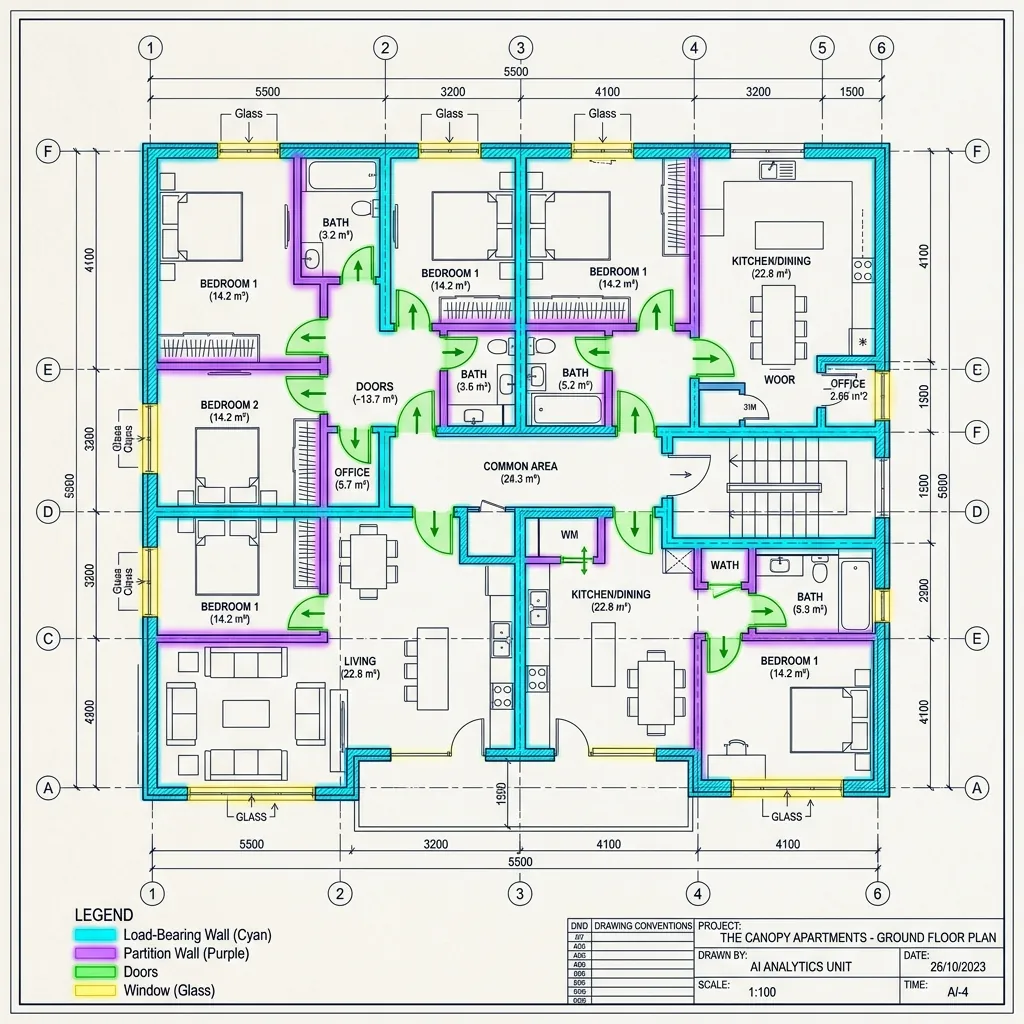
Why tuning is not optional
A drawing set is a private language
Your legend
The symbols your office uses, which no general model has ever seen.Your sheet stock
Vector exports, 300 DPI scans, phone photographs of a print — whichever you actually get.Your fields
The handful of values you use, tuned properly, rather than fifty measured loosely.Your threshold
What counts as good enough for the decision the output feeds into.
| Topic | Our models, before tuning | Tuned on your drawings |
|---|---|---|
| What it is for | Judging whether a job is feasible at all | Running as part of a workflow |
| Your symbols | Recognised only where they resemble common ones | Trained on your legend, from labelled examples |
| Accuracy | Generally above 80% on typical plans | Measured against a target you set, on your own sheets |
| Awkward cases | Handled inconsistently | Your convention applied the same way every time |
What a project looks like
From your first sheet to a model you own
Step 1: Scope on real drawings
about 2 business days
Send a sheet, ideally an awkward one. We run our models on it and tell you what already works, what needs tuning, and what is not worth automating at all.- Free
- No call required
- NDA on request
Step 2: Tune and measure
4–6 weeks
We label a representative sample of your sheets, tune the relevant stages, and score the result on a held-out set against your own manual work.- Target agreed before we start
- Scored on fields you nominate
Step 3: Run it, and keep it current
Ongoing
Deployed where the work happens, with corrections from review feeding the next round of training as your drawing mix changes.- You own the weights
- Retrained as drawings change
What we need from you
Less than teams expect
- A representative sample of your drawings, including the bad ones
- The fields you actually use, not every field imaginable
- Any existing manual results for those sheets — they become the ground truth
- Your conventions, for the cases where the drawing is genuinely ambiguous
Send the awkward sheets, not the clean ones. A tuned model is only as good as the range it was trained on, and a sample of your best drawings produces a model that fails on a Wednesday afternoon when a bad scan arrives.
What tuning will not fix
Some things are not a model problem
Information that is not on the drawing
If a dimension was never drawn, no amount of training will recover it. It can be inferred and flagged as inferred; it cannot be known.Drawings too degraded to read
There is a floor below which a scan carries no recoverable detail. We would rather identify that in the free analysis than bill for discovering it.A decision nobody has made
Where an open-plan space ends is a convention, not a fact. Until your team agrees one, no model can apply it consistently.
FAQ
Questions, answered
First, though — send us one sheet.
For a symbol class, typically tens of labelled instances rather than thousands — template matching gets a useful way there from a single example, and tuning is what makes it reliable. For a full pipeline across a varied drawing set, a representative sample across the styles you receive matters far more than raw volume.
You do. You own the weights we train for you and the data you give us. We do not reuse a client's drawings to train models for anyone else, and that is in the contract rather than a matter of goodwill.
We will not quote a number before seeing your drawings, because a figure measured on someone else's plans tells you nothing about yours. We agree a target on the specific fields you care about, then measure against it on a held-out sample of your own sheets. If it is not reached, that is reported rather than reframed.
They will, and a model tuned on last year's mix degrades quietly rather than loudly. Retraining on new material is part of the ongoing arrangement, fed by the corrections reviewers make during normal use.
Yes, where you have the team for it. Some clients want the pipeline and the training setup handed over to run in-house; others want us to keep running it. Both are normal, and it is worth deciding which before the project rather than after.
Get in touch
Tell us what is on your drawings
Describe the sheets you get and what you need off them. We will tell you what our models already handle, what needs fine-tuning on your drawings, and what is not worth automating at all.
- Reply time
- Within 1 business day
Would rather show than tell? Send one sheet for a free analysis