Floor plan data for valuation
Most automated valuation models know a property's total floor area, its bedroom count and its postcode. The floor plan sitting in the listing contains a great deal more, and almost none of it reaches the model.
This is not because the extra information does not matter. Anyone who has viewed two identically sized flats knows it does.
Gross area hides the thing buyers react to
Two homes at ninety square metres can be completely different products: one with a single large living space and one carved into five small rooms; one with circulation eating a fifth of the floor and one with almost none.
Buyers price that difference immediately on a viewing. A model working from a single area figure cannot see it at all, and the difference ends up in the residual — which is another way of saying the model is less accurate than it could be.
What comes off a plan
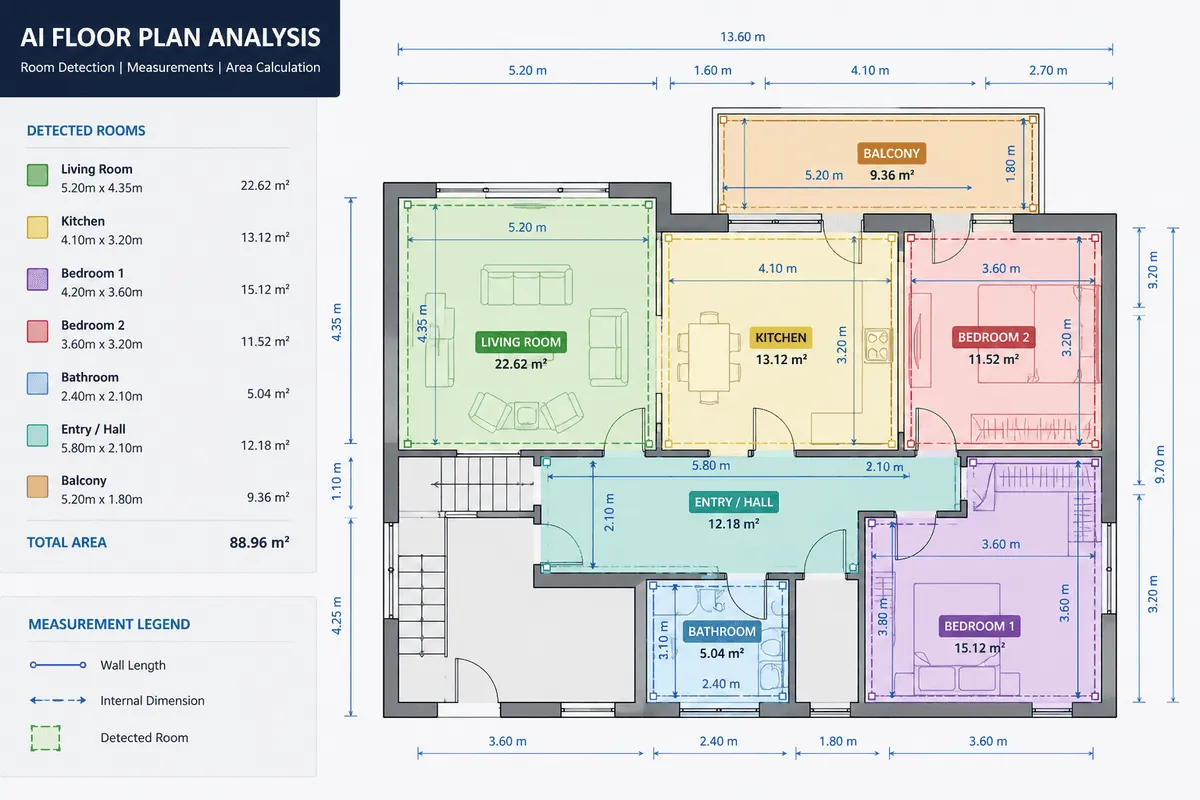
Once a plan is read into structured data, the available features change considerably.
- Net internal area against gross, and how much of the floor is circulation.
- Room-by-room areas, so the size of the main living space is a feature in its own right.
- Bedroom and bathroom counts derived from the plan rather than from a listing description.
- Outdoor and balcony space separated out instead of folded into a total.
- Adjacency: whether the kitchen opens to the living area, whether a bedroom is en suite, whether a bathroom opens off the main room.
- Aspect and window distribution, where the plan shows them.
Layout as a search dimension
The same structured output is useful well before valuation. Portals let buyers filter by bedroom count because that is the data they hold, not because it is what people care most about.
With an adjacency graph, harder and better questions become answerable: open-plan kitchen and living, a bedroom away from the road, a layout that could take a desk. These are the things buyers actually describe to agents, and they are currently unsearchable.
Two cautions
First, listing plans vary enormously in quality, and a lot of them are redrawn marketing graphics rather than measured drawings. Extracted areas inherit whatever the plan asserts, and a plan with no scale note produces no trustworthy area at all — better flagged than estimated.
Second, anything that feeds a valuation should carry confidence and be auditable. A field that goes into a published listing or a lending decision needs to be checkable against the sheet it came from, and gated on confidence rather than published because it parsed.