Automating takeoff: what really saves time
Takeoff automation is usually sold as a percentage: cut your takeoff time by some large number. That framing is unhelpful, because takeoff is several different activities and they do not automate equally.
It is worth separating them before deciding what a tool is actually worth to you.
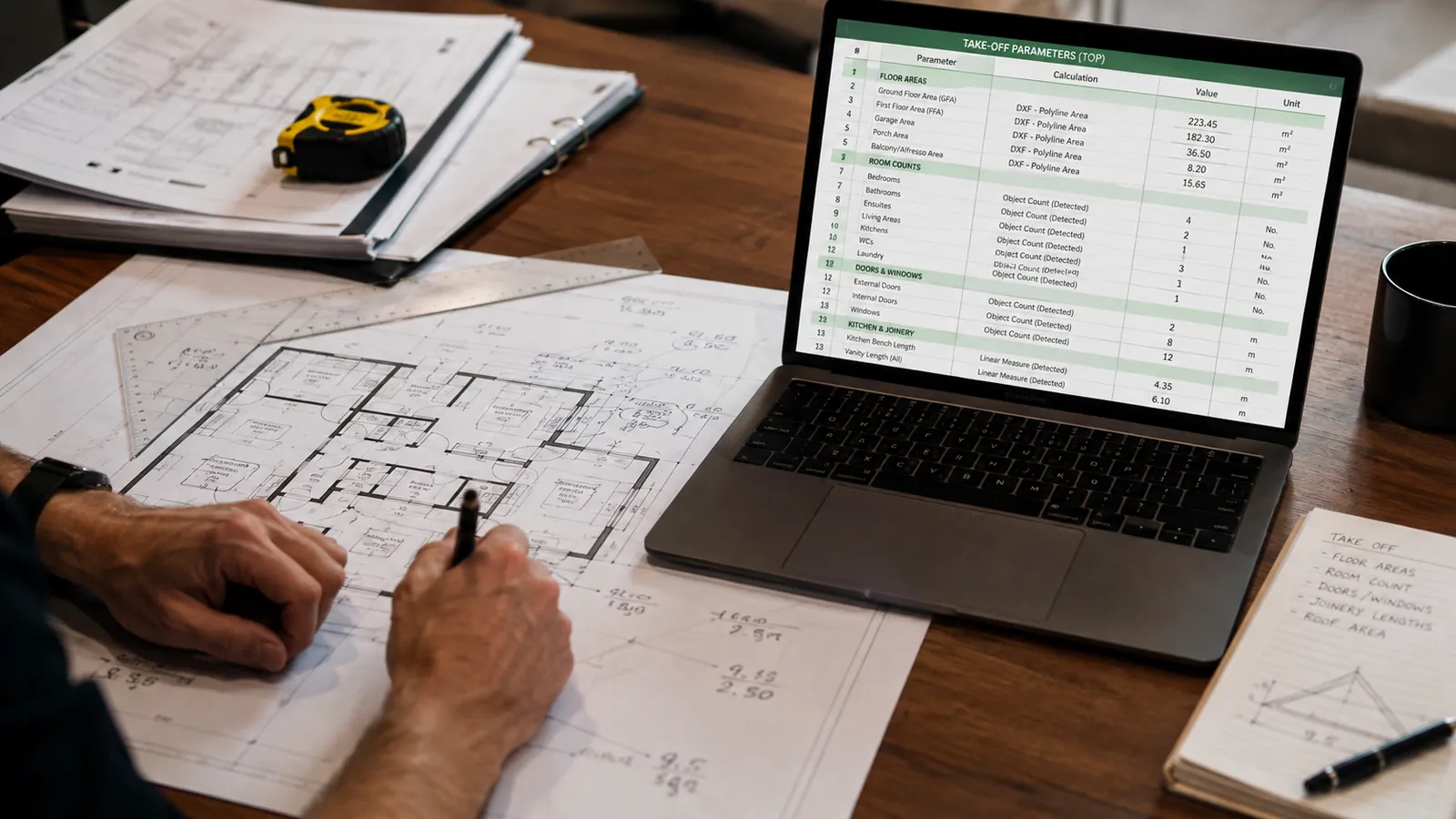
Three activities wearing one name
Measuring is reading quantities off the drawings: counting symbols, scaling wall runs, working out areas. It is mechanical, it is the bulk of the hours, and it is the part nobody enjoys.
Classifying is deciding what each thing is in your cost structure — which element class, which trade, which line of the bill. It is partly mechanical and partly convention.
Estimating is judgement. What the work will cost here, with this crew, at this time of year, at this risk. It is the part that wins and loses bids.
Measuring automates well
Once a drawing is structured data, measurement is arithmetic. Areas come from polygons, lengths from traced geometry, counts from enumerated detections. On drawings a model has been tuned for, work that took hours or days comes back in minutes.
The important caveat is that tuning. A pipeline that has never seen your symbol legend will miss things, and a count that is quietly short is worse than no count at all.
Classifying automates partly
Mapping detections to your element classes works once the mapping is agreed, and it mostly stays agreed. Where it breaks down is the cases the drawing renders ambiguously and your team resolves by convention — often a convention that has never been written down.
Those cases are worth surfacing at the start of a project. Half of them turn out to be genuine disagreements between people in the same office.
Estimating does not automate, and should not
No responsible pipeline should be pricing your work. The value of an estimator is precisely the judgement that cannot be read off a drawing, and a tool that obscures where measurement ends and judgement begins is a liability.
So what is the real saving?
Your estimators open a populated sheet instead of an empty one. The first days of a bid go to reviewing and pricing rather than to counting and scaling. Reissued drawings get re-measured in minutes rather than repeating the whole exercise.
Review does not disappear, and a vendor promising that it will is worth treating carefully. What changes is where the hours go — and for most practices that is the difference between the number of bids they can put out and the number they would like to.
- Automate: counting, scaling, area computation, re-measuring after a revision.
- Automate carefully: classification into your cost structure, once conventions are agreed.
- Do not automate: pricing, risk, and anything the drawings do not actually show.